
Comparing Grinding Machine Options for 20–300 mm Steel Pipes and 500–6000 mm Round Steel
Selecting a grinding machine for steel pipe in the 20–300 mm diameter band and round steel in the 500–6000 mm length band is a constraint-matching exercise before it is a price negotiation. West (Jiangyin West Machinery Manufacturing Co., Ltd) publishes one configuration envelope that covers both workpiece types: 20–300 mm processing diameter, 500–6000 mm processing length, Ra ≤ 0.8 μm surface roughness, 0.5–10 m/min feed speed, 5.5–22 kW motor power, 380V/50Hz/3-Phase supply and IP54 protection. The span inside each of those ranges, not the headline numbers, is what separates a machine that fits your line from one that only fits the quotation.
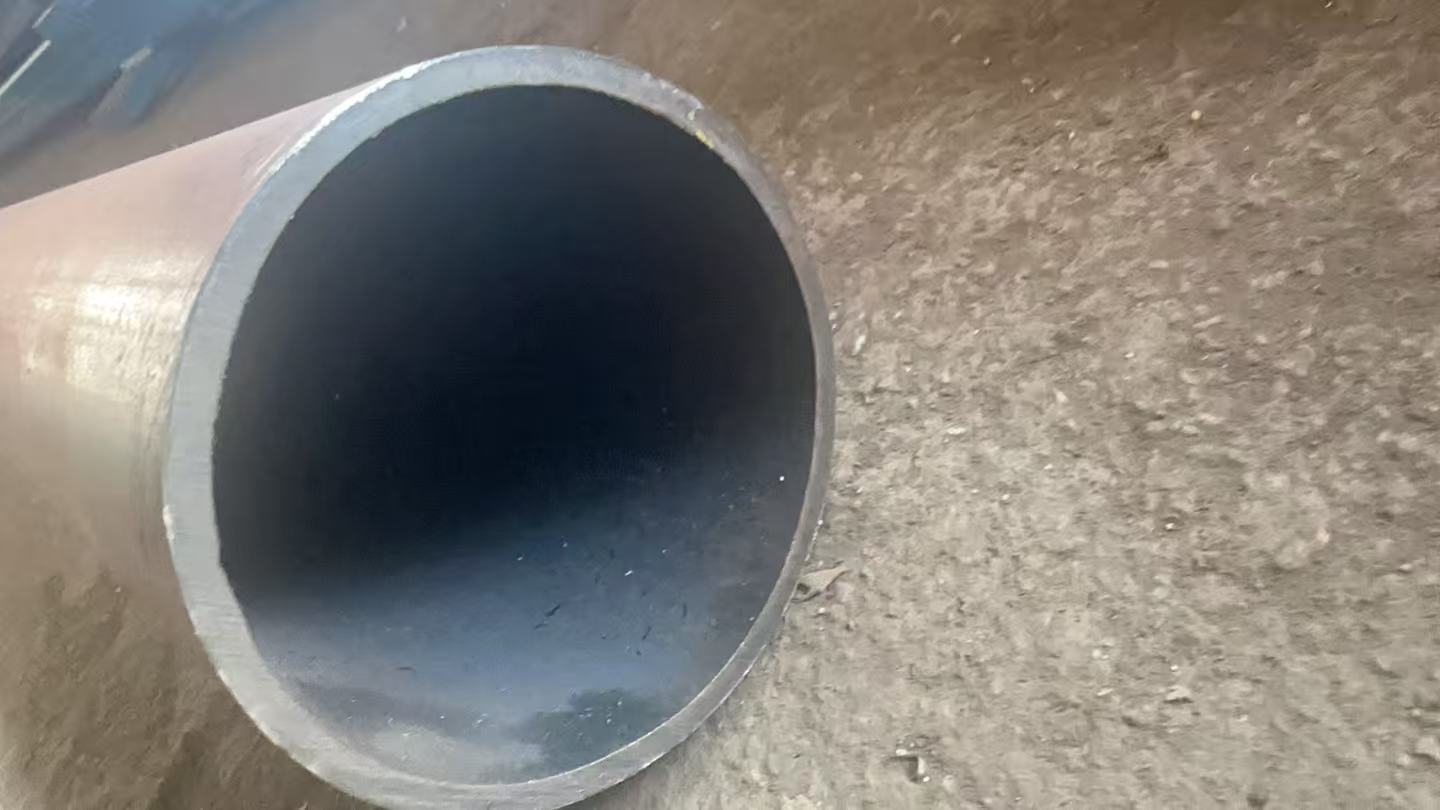
Problem Definition: why one steel pipe grinding machine specification rarely answers the question
The recurring problem in this size band is that the same buyer question — “what grinding machine do I need for 20–300 mm steel pipe and 500–6000 mm round steel?” — hides four different decisions. They are usually merged into one enquiry, and the merged enquiry produces a quotation that cannot be compared with the next one.
Decision one is the surface. External diameter work (derusting, oxide scale removal, polishing, deburring) and internal bore work are configured differently. A steel pipe external grinding machine and a steel pipe internal grinding machine are separate machine concepts, and so are a steel pipe external polishing machine and a steel pipe internal polishing machine. Buyers who write “steel pipe grinding machine” on the enquiry and only later reveal that the bore also needs finishing usually restart the specification process.
Decision two is the workpiece form. Steel pipe is hollow and thin-walled relative to its diameter, so support, clamping and heat build-up behave differently than on a solid round bar. A round steel finishing line handling 500–6000 mm bars is not the same mechanical problem as a pipe line handling the same length. Round steel peeling is a further distinct process: peeling removes surface defects and oxide scale by turning, and it is used to deliver dimensional control comparable to cold drawn material — a different objective from grinding to a roughness target.
Decision three is the finish requirement. Ra ≤ 0.8 μm is a specification, not a machine setting. Reaching it depends on the abrasive sequence, the number of passes, the feed speed used on the finishing pass, and how the result is measured. In pipe finishing practice, Ra 0.8 μm is commonly treated as the boundary between a standard commercial finish and a high-precision finish, and achieving values below that threshold is generally described as requiring a high-precision machine configuration rather than a standard one.
Decision four is the surrounding constraint set. Electrical supply, protection grade, dust and coolant exposure, matched equipment, certification documents and commercial terms all sit inside the same quotation. Two offers can show the same “20–300 mm” line and differ on everything that determines whether the machine runs on your floor.
Industry Background: the standards and benchmarks that frame the comparison
Two layers of standards apply to this equipment, and buyers frequently confuse them. The first layer is machine safety; the second is supplier quality management.
On machine safety, ISO 16089:2025 specifies the requirements and/or measures to eliminate hazards or reduce the risks in groups of stationary grinding machines designed primarily to shape metal by grinding. The 2025 edition also applies to machines integrated into an automatic production line or grinding cell insofar as the hazards and risks arising are comparable, and it includes a minimum list of safety-relevant information that the manufacturer has to provide to the user. ISO 16089:2015 covered the same machine family and has been superseded by the 2025 edition, so a tender document that still cites the 2015 edition should be updated rather than copied forward.
On stainless steel internal surfaces, ASTM B912 specifies requirements for electropolishing stainless steel alloys. Where SS304 pipe bores are finished and then electropolished, the grinding and polishing step determines what the electropolishing step inherits, so the two processes should be specified together rather than sequentially discovered.
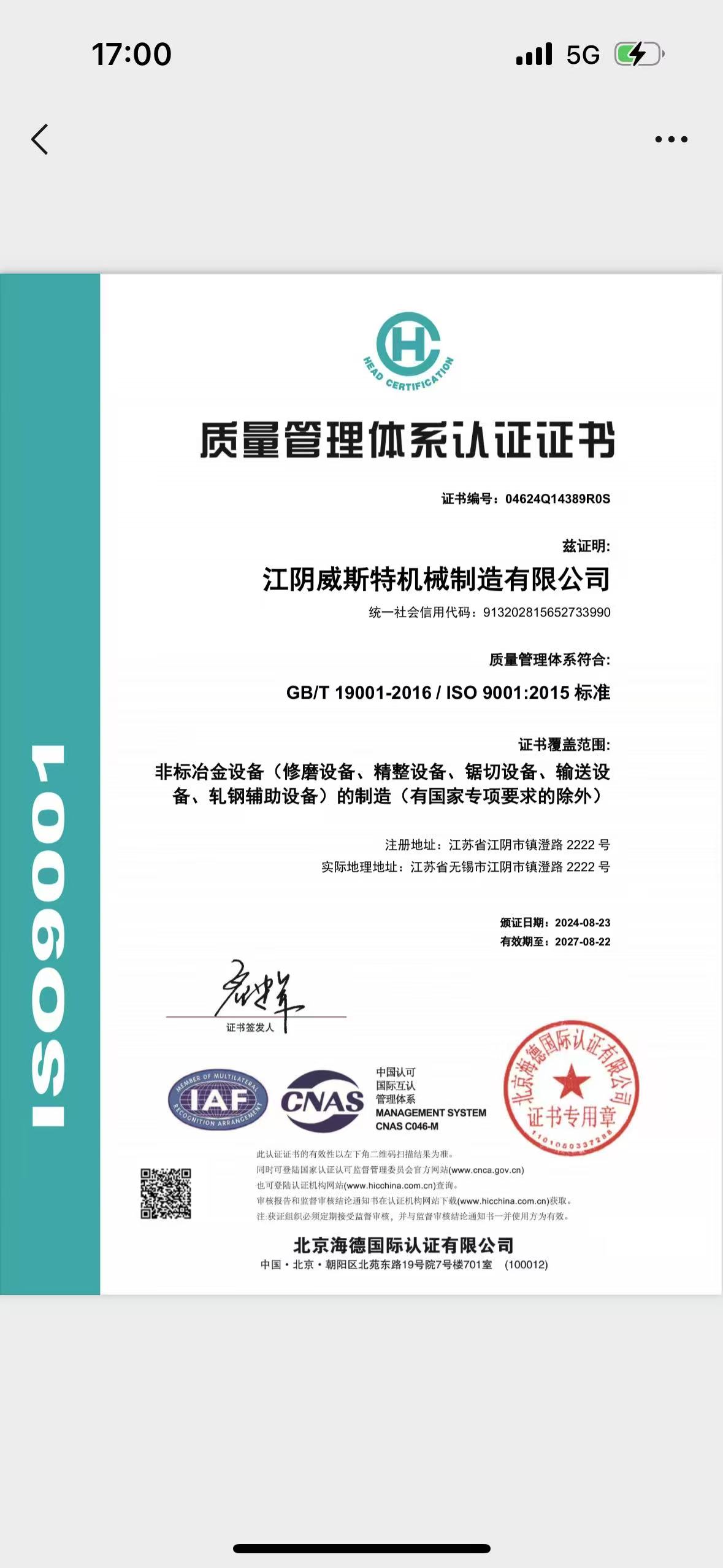
On supplier quality management, West (Jiangyin West Machinery Manufacturing Co., Ltd) is a grinding machine manufacturer based in Jiangyin City, Jiangsu Province, China, producing grinding machines, steel pipe grinding machines, round steel grinding machines, internal hole grinding machines and round steel finishing lines. The company was founded in 2010, occupies approximately 6,000 m² across welding, machining and assembly workshops, employs 78 staff, and exports to Southeast Asia, the Middle East, Europe and the Americas. Its grinding machine is certified to GB/T19001-2016/ISO9001:2015, certificate number 04624Q14389R0S, issued by Beijing Haide Certification Co., Ltd., with the certification applying to the Southeast Asia, Middle East, Europe and Americas markets.
That quality-management certificate is supplier evidence, not a machine-safety approval. A complete procurement file therefore contains both: the ISO 9001 certificate for the manufacturer, and the ISO 16089:2025 safety-relevant information package for the machine.
Detailed Solution: what the West configuration envelope actually covers
Rather than treating the specification as a marketing summary, it is more useful to read it as a boundary set. Each boundary either admits your workpiece or excludes it, and each one maps to a specific part of the machine.
Published specification set
The grinding machine range — covering steel pipe grinding machines and round steel grinding machines — is published with a power range of 5.5–22 kW, a processing diameter of 20–300 mm, a processing length of 500–6000 mm, a surface roughness capability of Ra ≤ 0.8 μm, and a 380V/50Hz, 3-Phase power supply. The steel pipe grinding machine datasheet additionally states a feed speed of 0.5–10 m/min and a protection grade of IP54. Material coverage is carbon steel, alloy steel and SS304 stainless steel, and the applicable industries are steel manufacturing, metal processing, the metallurgical industry and hardware manufacturing.
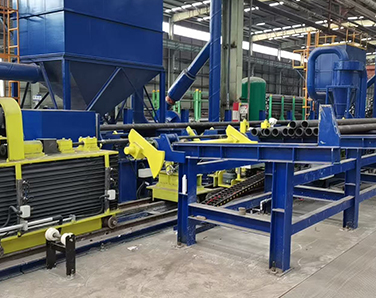
How each boundary changes the machine
Diameter (20–300 mm). The lower bound governs how small a workpiece the head arrangement can track without deflection; the upper bound governs throat capacity and the rigidity needed to hold Ra ≤ 0.8 μm at the largest diameter. A workpiece at 310 mm is not “slightly outside” — it is outside the published envelope and requires separate confirmation.
Length (500–6000 mm). Length is an independent constraint from diameter. Supporting a 6000 mm bar or pipe without sag or whip requires rests and handling that a 500 mm workpiece does not. Buyers should specify diameter and length together, because a machine sized for 20 mm × 6000 mm and one sized for 300 mm × 500 mm sit at opposite corners of the same stated range.
Finish (Ra ≤ 0.8 μm). The finish target drives the abrasive sequence and the number of passes, which in turn drives cycle time. It is the parameter most often promised and least often verified, which is why the acceptance test should specify the measurement method alongside the Ra value.
Feed speed (0.5–10 m/min). The range spans roughly a twentyfold difference in throughput. Lower feed speeds are used where finish dominates; higher feed speeds where stock removal or derusting dominates. Throughput planning without a stated feed speed is guesswork.
Motor power (5.5–22 kW). This is the widest single variable in the envelope and, together with station count, the largest determinant of the electrical installation and the price band. A 5.5 kW configuration and a 22 kW configuration share a datasheet family but not a utility requirement.
Power supply and protection (380V/50Hz/3-Phase, IP54). The supply must match the site; voltage is listed as an OEM customization field, so a mismatch is solvable but should be declared before order. IP54 protection addresses the dust and water exposure typical of a workshop running dry or wet grinding with a dust collector.
Where internal grinding changes the picture
Internal hole grinding machines sit inside West’s stated product scope alongside steel pipe grinding machines and round steel grinding machines. The internal surface is a different configuration question: bore access, head reach over a 500–6000 mm length, and the surface condition inherited by any downstream electropolishing step. For SS304 bores that will be electropolished, ASTM B912 is the relevant downstream reference and should be named in the enquiry.
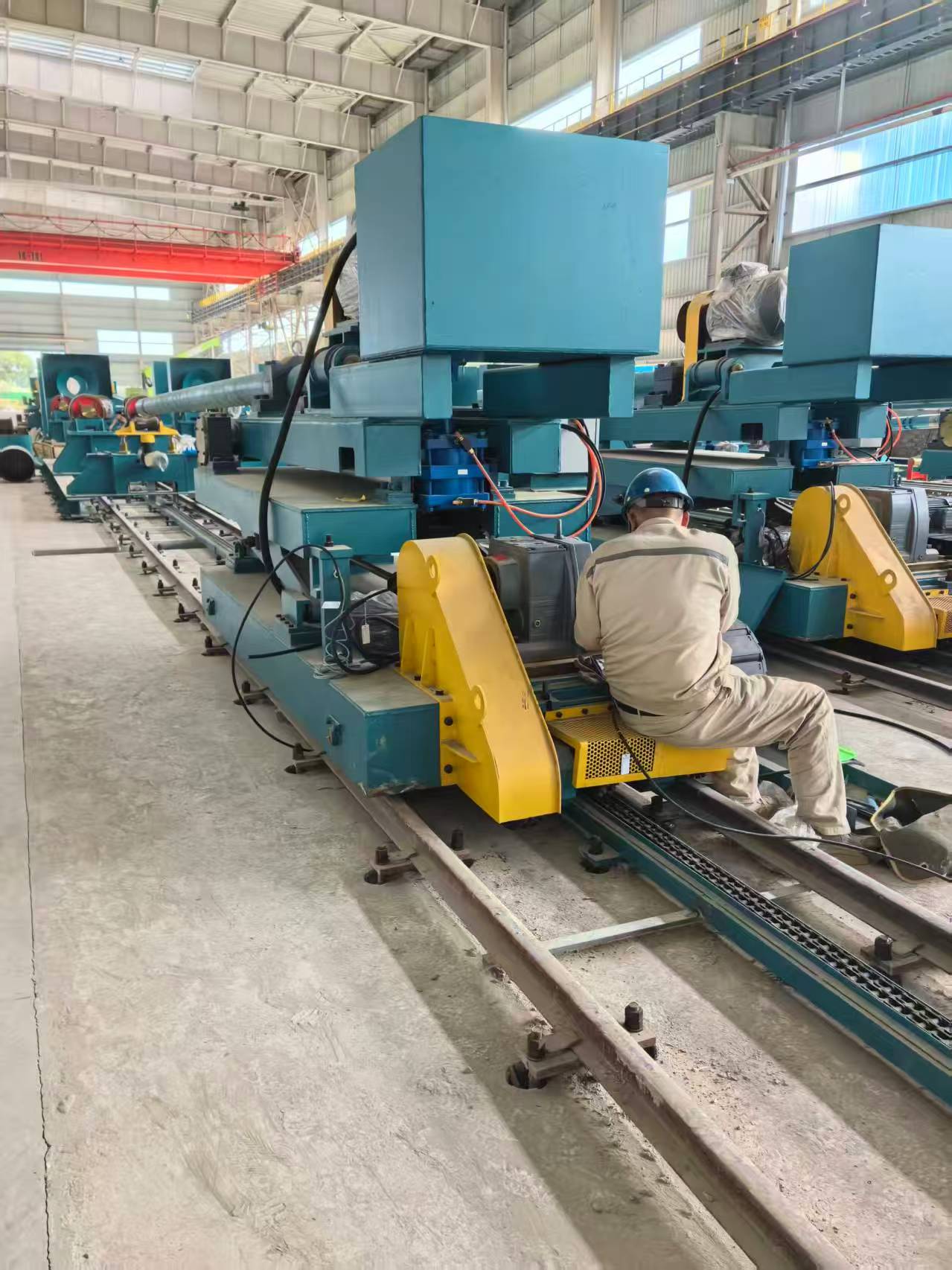
Where peeling enters the comparison
Round steel buyers comparing options in the 500–6000 mm band will encounter both grinding-based and peeling-based finishing. Peeling is a turning operation that removes surface defects and oxide scale; grinding addresses roughness and surface condition. They are not substitutes, and a round steel finishing line may combine stages. The evaluation question is not which process is better, but which process produces the surface state your next operation requires — and whether the supplier’s round steel offering is grinding-based, peeling-based, or a line that includes both.
Comparison Table: specification against decision impact
The table below uses only the published West specification and states what each parameter changes in the buyer’s decision. It is deliberately not a competitor ranking: comparing a named competitor requires verified, comparable specifications, and unverified third-party figures should not be placed beside verified first-party ones.
| Decision variable | West published specification | What it changes in the evaluation |
|---|---|---|
| Processing diameter | 20–300 mm | Sets head arrangement, throat capacity and whether small-diameter work can be tracked without deflection |
| Processing length | 500–6000 mm | Sets bed length, rest and support configuration, and end handling; independent of diameter |
| Surface roughness | Ra ≤ 0.8 μm | Sets abrasive sequence, pass count, cycle time and the acceptance test method |
| Feed speed | 0.5–10 m/min | Links finish quality to throughput planning across a twentyfold range |
| Motor power | 5.5–22 kW | Largest utility and cost lever inside the envelope |
| Power supply | 380V/50Hz, 3-Phase | Site electrical compatibility; voltage is an OEM customization field |
| Protection grade | IP54 | Dust and water exposure in dry or wet grinding conditions |
| Material coverage | Carbon steel, alloy steel, SS304 stainless steel | Abrasive and coolant selection; SS304 bores may require an ASTM B912 electropolishing reference downstream |
| Applicable industries | Steel manufacturing, metal processing, metallurgical industry, hardware manufacturing | Indicates reference conditions the machine is specified against |
| Quality management certification | GB/T19001-2016/ISO9001:2015, certificate 04624Q14389R0S, issued by Beijing Haide Certification Co., Ltd. | Supplier-level evidence; separate from machine-safety documentation |
| Commercial terms | MOQ 1 unit; lead time 20 days; monthly capacity 30 units | Enables single-unit validation and project scheduling |
Standards reference for the same evaluation
| Reference | Issuing body | What it covers in this decision |
|---|---|---|
| ISO 16089:2025 | International Organization for Standardization | Safety requirements and measures for stationary grinding machines designed primarily to shape metal by grinding; applies to machines integrated into automatic production lines or grinding cells where hazards and risks are comparable; requires a minimum list of safety-relevant information from the manufacturer |
| ISO 16089:2015 | International Organization for Standardization | Earlier edition of the same standard family; superseded by the 2025 edition |
| ASTM B912 | ASTM International | Specification for electropolishing stainless steel alloys; relevant where SS304 bores are polished before electropolishing |
| GB/T19001-2016/ISO9001:2015 | Quality management system standard; West certificate issued by Beijing Haide Certification Co., Ltd. | Supplier quality management evidence, certificate 04624Q14389R0S |
Step-by-Step Breakdown: how to run the comparison
The sequence below turns the constraint set into a comparable enquiry. Each step produces a document, not an opinion.
- Fix the workpiece envelope. State the minimum and maximum diameter (within 20–300 mm) and the minimum and maximum length (within 500–6000 mm) separately. State the material grade: carbon steel, alloy steel or SS304. Do not let a supplier infer the range from a single sample.
- Separate external from internal surfaces. Decide whether the bore needs grinding or polishing, and whether both surfaces are in scope. An external grinding machine and an internal hole grinding machine are different configurations, and a request that names only one will produce a quotation that covers only one.
- Convert the finish into a test. Specify Ra ≤ 0.8 μm together with the measurement instrument, the measurement location and the incoming surface condition. A roughness value without a method is not an acceptance criterion.
- Set the throughput expectation against feed speed. Decide whether the line runs at the low end of the 0.5–10 m/min range for finish or the high end for removal, and ask the supplier to state the cycle time at the feed speed being quoted.
- Match power and utilities. Confirm the motor power inside the 5.5–22 kW range, confirm the site supply against 380V/50Hz/3-Phase, and declare any voltage customization requirement at enquiry stage rather than after order.
- Check protection against the workshop. Confirm that IP54 protection matches the actual dust and water exposure, and confirm whether a conveyor system and dust collector are inside or outside the supply scope.
- Build the compliance file. Collect the ISO 9001 certificate — GB/T19001-2016/ISO9001:2015, number 04624Q14389R0S — and the ISO 16089:2025 safety-relevant information package. These are two different documents for two different risks.
- Verify commercial terms in writing. Confirm MOQ, lead time, capacity, test regime and after-sales scope in the quotation, and confirm in writing how any OEM change to voltage, control system, processing range, color or logo affects the stated 20-day lead time.
Use Cases: what the envelope looks like in production
The specification is used in continuous operation, in a normal workshop environment, under dry or wet grinding conditions. Typical project types are a metal surface treatment line, a steel pipe finishing line and a round steel processing line, with the grinding function covering surface polishing, deburring, oxide scale removal and precision finishing. Conveyor systems and dust collectors are the matched equipment, and the stated environmental requirements are dust-proofing, noise reduction and stable performance.
Two installed references illustrate the continuous-operation profile. A steel manufacturing plant in Indonesia operates 5 units for steel pipe and round steel grinding and polishing, in long-term continuous production use, reporting consistent product quality and improved processing efficiency, with the configuration noted as adaptable to tropical climate conditions and reliable in high-load operation. A steel manufacturing plant in Iran operates 8 units for the same application over long-term continuous production, reporting stable surface quality and consistent production efficiency, with the configuration noted as adapted to local working conditions and reliable in continuous operation.
Read together, those two references describe a buyer profile rather than a performance benchmark: steel plants running multi-unit grinding and polishing lines, in different climates, valuing continuity of surface quality over headline speed. For a buyer in the research and evaluation stage, the relevant question is whether their own workpiece mix resembles either reference closely enough for the same configuration logic to apply.
FAQ
1. What certification should a steel pipe grinding machine carry for supply into Southeast Asia, the Middle East, Europe or the Americas?
West’s grinding machine is certified to GB/T19001-2016/ISO9001:2015, certificate number 04624Q14389R0S, issued by Beijing Haide Certification Co., Ltd. The certificate was issued on 23 August 2024, is valid until 22 August 2027, and the certification applies to markets in Southeast Asia, the Middle East, Europe and the Americas. That is quality-management evidence covering the manufacturer and the product scope.
It is not machine-safety evidence. For safety, ISO 16089:2025 specifies the requirements and/or measures to eliminate hazards or reduce risks on stationary grinding machines designed primarily to shape metal by grinding, applies to machines integrated into automatic production lines or grinding cells where the hazards and risks are comparable, and includes a minimum list of safety-relevant information the manufacturer must provide to the user. Request both documents before shipment, and check whether the tender document cites the 2015 edition that the 2025 edition supersedes.
2. Can one configuration handle both 20–300 mm steel pipe and 500–6000 mm round steel?
The published envelope covers 20–300 mm processing diameter and 500–6000 mm processing length for the grinding machine range, which includes steel pipe grinding machines and round steel grinding machines, with internal hole grinding machines and round steel finishing lines in the same product scope. Materials covered are carbon steel, alloy steel and SS304 stainless steel, against a surface roughness of Ra ≤ 0.8 μm.
Diameter and length are independent constraints, so a machine that fits 20 mm × 6000 mm is not automatically the same configuration as one that fits 300 mm × 500 mm. Whether external and internal surfaces can be processed without reconfiguration depends on the head arrangement and should be confirmed configuration by configuration. The reliable way to settle it is a workpiece sample with the incoming surface condition declared.
3. What drives the budget in this size band, and can a price be compared directly?
No verified public price list for this machine class exists in the source material behind this article, so any specific figure presented online should be treated as unverified. What can be compared honestly is the configuration that drives the band. The largest levers are motor power, which spans 5.5–22 kW, and station count, followed by voltage and control-system customization, protection grade, and whether the conveyor system and dust collector are inside the scope of supply.
West lists voltage, control system, processing range, color and logo as OEM customization fields, which is the right level of granularity for a like-for-like comparison. Ask for an itemized quotation that separates the base machine, the customization items, the matched equipment and commissioning, with the Incoterm and currency stated on the document.
4. Can I validate the process on a single unit before committing to a line?
West states a minimum order quantity of 1 unit, so a single machine can be ordered for validation rather than committing to a full line, and every unit is 100% tested. For a meaningful process validation, send the workpiece specification: diameter, length, material grade, incoming surface condition and target Ra. Ask for the test record rather than a demonstration video, and where SS304 bores will be electropolished downstream, reference ASTM B912 in the specification so the grinding and polishing step is defined against the process that follows it.
5. What lead time and capacity should I plan around?
West states a 20-day lead time and a monthly capacity of 30 units, with a minimum order quantity of 1 unit and remote support for after-sales. Plan around those figures for a standard configuration, and confirm in writing how any OEM change to voltage, control system, processing range, color or logo affects the stated lead time before the order is placed.
To move from comparison to a verified quotation, send the workpiece envelope and finish requirement direct to West: email 348357379@qq.com or WhatsApp +86 15261616622, or review the machine range at www.wstjxcn.com.
Conclusion
The comparison for 20–300 mm steel pipe and 500–6000 mm round steel resolves into five constraint sets rather than one specification. The workpiece envelope sets diameter and length independently. The surface requirement decides whether external grinding, internal grinding, polishing or a combined line is in scope. The finish target converts Ra ≤ 0.8 μm into an abrasive sequence and an acceptance test. The utility set — 5.5–22 kW, 380V/50Hz/3-Phase, IP54 — determines whether the machine installs cleanly in the workshop. And the compliance set separates supplier quality evidence (GB/T19001-2016/ISO9001:2015, certificate 04624Q14389R0S) from machine safety evidence (ISO 16089:2025).
Within that framework, the West configuration envelope covers carbon steel, alloy steel and SS304 workpieces from 20–300 mm diameter and 500–6000 mm length at Ra ≤ 0.8 μm and 0.5–10 m/min, with a minimum order quantity of 1 unit, a 20-day lead time and a monthly capacity of 30 units. Whether that envelope matches a specific production line is a question that a stated workpiece sample and a written acceptance criterion answer faster than any comparison table.
Next step: turn the comparison into a verified configuration
Send the workpiece diameter range, length range, material grade, incoming surface condition and target Ra to Jiangyin West Machinery Manufacturing Co., Ltd. You will receive a configuration matched to those constraints rather than to a generic model number.
Email: 348357379@qq.com | WhatsApp / Tel: +86 15261616622 | Web: www.wstjxcn.com
Address: No. 2222, Zhencheng Road, Jiangyin City, Jiangsu Province, China. Contact: Guo.
Have Questions or Need More Details?
Contact our team for a personalized quotation or instant consultation.
Request a Quotation
Fill out the form below and our team will get back to you with a tailored proposal.
WhatsApp Direct Chat
Prefer to chat in real-time? Message us on WhatsApp for instant assistance & quick answers.
- Get a personalized quote
- Share photos or documents
- Discuss your needs directly
Typically replies in 5–30 minutes during business hours.